
















Asteroid (also called planetoid) - A medium-sized rocky object that orbits the Sun. It's smaller than a planet but larger than a meteoroid. Also, any number of small bodies that revolve around the Sun.
Atmosphere - The air all around Earth.
Black Hole - An object with gravity strong enough to suck anything into it, even light.
Celestial Bodies - Natural objects visible in the sky - planets, stars, meteoroids, etc.
Comet - A giant snowball of ice and dust that revolves around the Sun. When it gets near the Sun, ice melts and looks like a tail. Haley's comet is probably the most famous comet.
Constellation - A group of stars that make a shape (they look like connect-the-dots) - usually named after mythological characters, people, animals and things.
 Constellation
Eclipse - This is when one celestial body cuts off the light of another - like when the moon covers the Sun for a brief moment.
Galaxy - A large group of stars. Our galaxy (called the Milky Way) includes the Sun.
Gravity - The natural force of attraction that pulls objects together - this is also what keeps our feet on the ground.
Great Red Spot - A huge colorful swirl of gases that spin counterclockwise on Jupiter.
Light Year - The distance light travels in a vacuum in one year (about 9.5 trillion km/6 trillion miles.)
Meteor (also a shooting star or a falling star) - A bright streak of light in the sky caused by a meteoroid or a small icy particle as it burns up entering Earth's atmosphere. Very large, bright ones are called fireballs and bolides.
Meteorite - A part of a meteoroid found on Earth.
Meteoroid - A small rock in space.
Orbit - The path that an object moves around a second object or point. For example, Earth orbits the Sun.
Planet - An object bigger than an asteroid orbiting a star. Our solar system has nine planets.
Satellite - A body that revolves around a larger body. The moon is a satellite of Earth. High-tech manmade satellites orbit Earth and the Sun, transmitting pictures, TV channels and phone signals.
Shooting Star - See meteor.
Solar System - The Sun, the nine planets and any other celestial bodies that orbit the Sun.
 Solar System
Solar Wind - A thin flow of energetic and gas charged particles that stream from the Sun. These blow throughout the solar system at speeds of hundreds of kilometers per second.
Speed of Light - 299,792,458 meters/second (186,000 miles/second.) Einstein's Theory of Relativity says that nothing can go faster than the speed of light. Of course, the crew on the Starship Enterprise knows better.
Star - Any celestial body that is visible at night (because it's brightly lit) from Earth at night.
Universe - All the matter and energy out there - this includes the Earth, galaxies, solar systems, you, your favorite pop star and everything else.
White Dwarf - The 'remains' of a star after it has collapsed. It is white looking (because it's so hot) and is extremely dense.
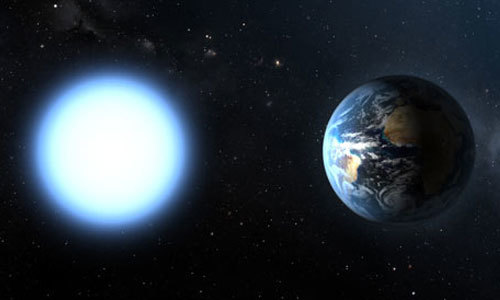 Space Term - White Dwarf
Related Stories:
- Great Beyond - Saturn and Its Many Rings
- Great Beyond - New Planet Discovered
- Great Beyond - Pluto: The Smallest