















There are no brakes, no steering and riders fly head first around curves as fast as the space shuttle heads toward space. This isn't some kind of bizarre death race - it's skeleton racing and it reappeared at the Olympics in 2002 for the first time in more than 50 years.
Skeleton Racing - How It Started
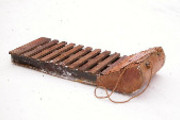
Skeleton racing was invented by British tourists in Switzerland in the 1800s. Sliders would race down a hill between two towns and the winner would receive a bottle of champagne. The sport received its name when a new sled that was made mostly of metal was introduced. People thought it looked like a skeleton.
Skeleton Racing - How It Works
Sliders push the skeleton for about 40 meters before diving onto the sled headfirst and tucking their arms under their body. They then fly down an icy and curvy track at speeds of nearly 90 miles per hour. While going through some curves, sliders experience five Gs of force - the equivalent of a space shuttle takeoff. The sleds have no brakes or steering wheel - sliders control the sled by turning their bodies. The only way to stop is to run out of slope or crash into something.
Skeleton Racing - The Olympic Story
Skeleton appeared at the Olympics for the first time in 1928 - and then disappeared until the 1948 Winter Olympics. The IOC dropped the sport again until 2002. The 2002 Winter Olympics were the first time women were allowed to compete in the sport. Americans proved to be the top sliders in skeleton racing's return to the Olympics. Jimmy Shea won the gold medal for the USA, becoming the third generation in his family to compete in the Winter Olympics. His dad competed in cross-country skiing at the 1964 Winter Olympics and his grandpa won two Olympic gold medals in speedskating events at the 1932 Games. American Tristin Gale won the women's skeleton event while sporting red, white and blue streaks in her hair. Fellow American, Lea Ann Parsley took the silver. It was all downhill for the US in 2006 though, with Canada and Switzerland stepping up their game to take the five of the six skeleton medals. The sixth medal went to Great Britian.
Skeleton Racing - Crash and Burns
When sliders are racing at high speeds on a sled with no brakes, it's not surprising that there are a lot of wipeouts and injuries. Lots of racers strain their necks going around the turns or bang their heads against the track. Chris Soule, who races skeleton for the United States, lost his grip on the handle of a sled during a qualifying race. He tried to grab on again but his hand got caught between the sled and the wall and the pressure split his palm open. In 2001, a racer in Latvia was killed when his sled plowed into an empty bobsled that was on the track.
Related Stories: