


















Is there another country in the world as proud of its flag as Americans are of the Star-Spangled Banner? An interesting thing about the stars and stripes is how much it has changed over the years – and also how much it has stayed the same. Starting out with just 13 stars and adding more and more until the total count reached 50, the evolution of the American flag tells the history of the entire nation. From New York to Alaska to Hawaii – the flag represents every American on it, somewhere in one of those white, five-pointed stars.
Fremont Flag
In the 1840s, army general John C. Fremont explored widely in the west. He carried a special flag with him that was made by his wife. It featured an eagle from the national crest holding a peace pipe in its talons as a sign to the Native Americans that he wanted to be friendly.
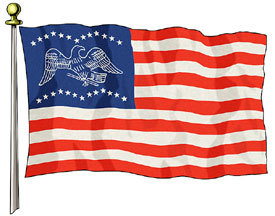 Fremont Flag
The First Confederacy Flag
When the Confederacy seceded in 1861, it adopted the Stars and Bars as its first flag. It featured two red bars with a white bar in the middle, as well as a blue patch with seven white five-pointed stars on it. The seven stars represented the seven original Confederate States: South Carolina, Mississippi, Florida, Alabama, Georgia, Louisiana and Texas.
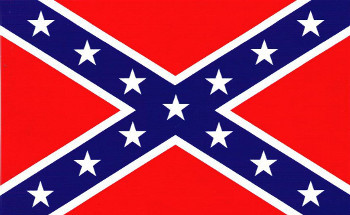 Confederate Flag
Old Glory
William Driver, a sea captain from Salem, Massachusetts, was awarded a 24-star flag he named Old Glory. When he retired to Nashville, it flew above his home until Tennessee seceded from the Union, at which time he hid the flag. Rebels wanted to destroy Old Glory, but were unsuccessful. When Union troops recaptured Nashville in 1862, the citizens of the city asked Driver to bring the flag out again. He cut open the bedspread where he’d hidden it and climbed to the top of the Capitol to raise Old Glory over the city again.
Timeline Of The Flag
As America changed and grew, so did the number of stars on the official U.S. flag:
- 1776: Grand Union Flag (red-and-white horizontal stripes and a Union Jack)
- 1777: Union Jack replaced by 13 stars to represent the states in the original Union
- 1795: Vermont and Kentucky join the Union (15 stars)
- 1818: Tennessee, Ohio, Louisiana, Indiana and Mississippi join (20 stars)
- 1819: Illinois joins (21 stars)
- 1820: Alabama and Maine join (23 stars)
- 1822: Missouri joins (24 stars)
- 1836: Arkansas joins (25 stars)
- 1837: Michigan joins (26 stars)
- 1845: Florida joins (27 stars)
- 1846: Texas joins (28 stars)
- 1847: Iowa joins (29 stars)
- 1848: Wisconsin joins (30 stars)
- 1851: California joins (31 stars)
- 1858: Minnesota joins (32 stars)
- 1859: Oregon joins (33 stars)
- 1861: Kansas joins (34 stars)
- 1863: West Virginia joins (35 stars)
- 1865: Nevada joins (36 stars)
- 1867: Nebraska joins (37 stars)
- 1877: Colorado joins (38 stars)
- 1890: North Dakota, South Dakota, Montana, Washington and Idaho join (43 stars)
- 1891: Wyoming joins (44 stars)
- 1896: Utah joins (45 stars)
- 1908: Oklahoma joins (46 stars)
- 1912: New Mexico and Arizona join (48 stars)
- 1959: Alaska joins (49 stars)
- 1960: Hawaii joins (50 stars)
The Making Of The Flag
During the Revolution, the American forces consisted of different colonies, and each colony was used to its own flag. George Washington, leading the American forces, wanted a single flag to unite them all together. He asked a seamstress named Betsy Ross to come up with a design – he even gave her sketch of a flag with 13 stars and 13 stripes on it. Ross liked Washington’s diagram, but rejected his use of six-sided stars. Instead, she showed him how to make a five-sided star with one cut of a single piece of cloth.
 Betsy Ross and the first flagCourtesy of About.com
Flying On The Moon
In 1969, the American flag went somewhere no man had ever gone before. When Neil Armstrong and Buzz Aldrin took their first steps on the surface of the moon, the put up a three-by-five foot flag. NASA had invented a special lightweight flagpole with a telescoping horizontal bar to stiffen the flag outward, while wire inside the flag’s nylon fabric made it look like it was flying – even though there’s no wind on the moon.
Related Links:
- Statue Of Liberty Facts
- Hispanic Culture And Traditions
- Black History Month
- Pledge Of Allegiance Debate